
The English Bible Today
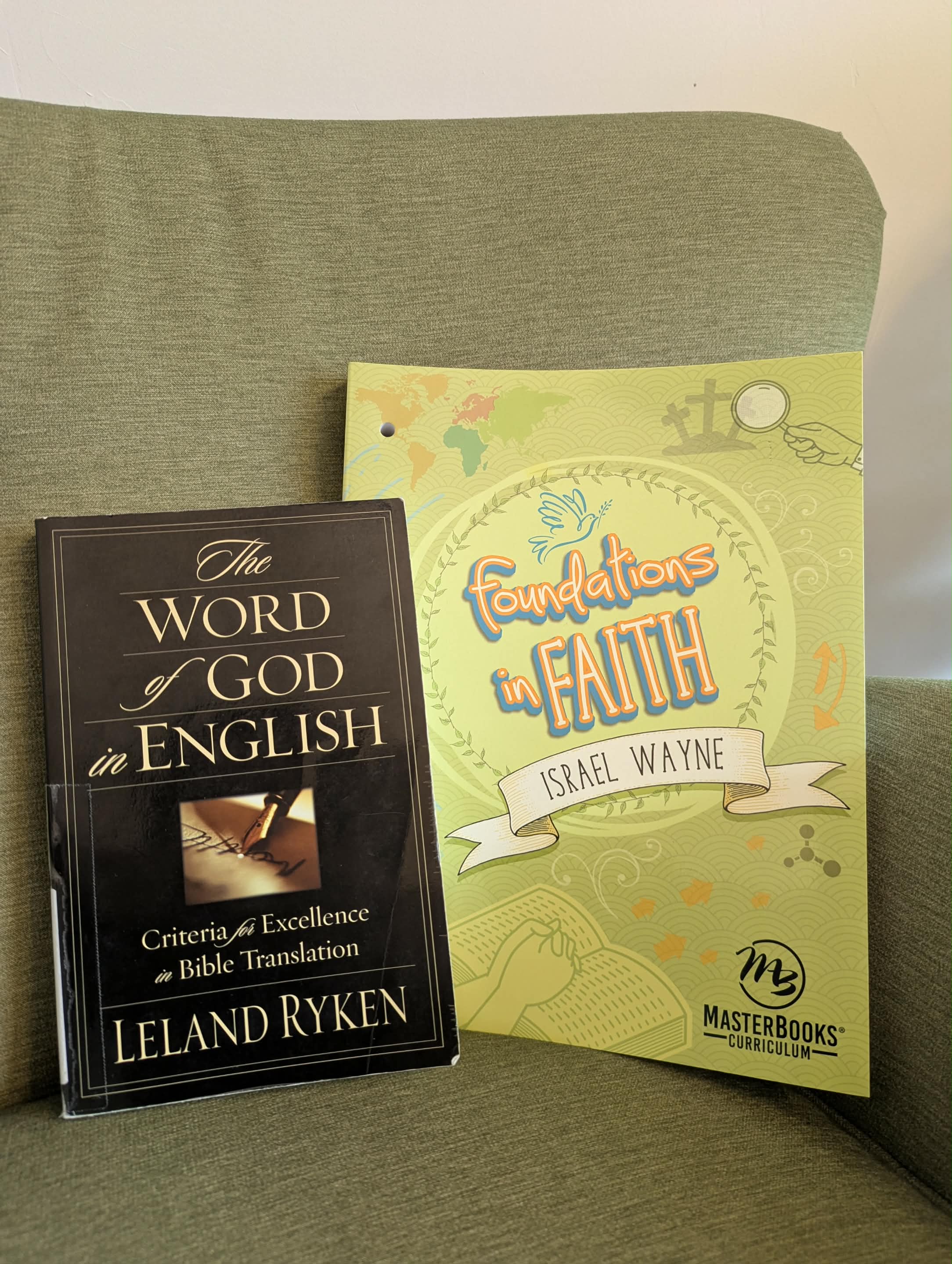
While going through a lesson from MasterBooks’ Foundations in Faith with my two homeschooling kids, I was reminded of the life and influence of William Tyndale during the early days of the Protestant Reformation. He lived in a time of varying power struggles: from what would become Italy, the influence of the Roman Catholic Church; from Germany, the influence of Martin Luther and his 99 theses; and from England, the influence of King Henry VIII. Amid all this cultural chaos, Tyndale finds his purpose: to translate the Bible into English so that all may enjoy reading it personally. He was dedicated to this translation no matter the cost, which was his life.
What has been the by-product of William Tyndale’s life? As the above-mentioned curriculum states, “His Bible translation became the basis for The Great Bible (published by Miles Coverdale in 1539), The Geneva Bible (1557), and the King James Version, published in 1611. [Tyndale] has had a tremendous impact on nearly every major English translation since. The mass evangelism of the world, especially beginning in the 19th century was based largely from English-speaking lands that were given the Word of God by William Tyndale. Millions of souls have come to faith in Christ because of Tyndale’s work and sacrifice” ( Wayne 56). In short, Tyndale paved the way for English Bibles getting into the hands of English-speakers.
Though the King James version was…umm…“king” for centuries, the last 50 years has seen the development of dozens of translations. From the New American Standard (NASB) to the New International Version (NIV) to The Message, readers can now choose a version that suits their purposes. However, choosing a translation can be daunting! What are the differences? Can all versions be trusted? And how do I choose? Well, friend, let’s explore some answers to those questions.
What are the differences?
Since the 1970s there has been a wide variety of Bible translations created and published, and they are basically divided into two categories: word-for-word translation and thought-for-thought translation. The former is focused on direct and “essentially literal” translation of the Bible from the Hebrew, Greek, and Aramaic to English. These translations include the King James Version (KJV), New King James Version (NKJV), English Standard Version (ESV), and New American Standard (NASB). Without getting too technical, I’ll mention that the difference between the KJV/NKJV and ESV/NASB is which source manuscripts each used. In recent years the NKJV, ESV, and NASB all sought to maintain the heart of KJV but in modern English, because, let’s be honest, the KJV was “badly showing its age and had become culturally obsolete with its archaic language and deficient scholarship” (Ryken 15).
Also in response to the aging NKJ was a new philosophy of translation; the primary concern of thought-for-thought was to not only render the words into English but to translate the foreign or unclear texts, cultural references, and literary techniques into modern cultural equivalences. Some thought-for-thought translations have tried to stick to the middle of the road, so to speak, while others have gone way out to left field. Examples of thought-for-thought translations include the New International Version (NIV), New Living Translation (NLT), Contemporary English Version (CEV), and The Message (MSG). These versions of the Bible would consider the assumed target-audience is the primary concern when considering how to translate, while the word-for-word would consider the author’s original words are the primary concern. This seemingly innocent difference does lead us to consider the trustworthiness of a translation as Leland Ryken so effectively lays out in his book The Word of God in English.
Can all versions be trusted?
The goal in answering this question is not to place an opinion on you, but to give a bit of food for thought when choosing a version of the English Bible to read. A bit of information to enable critical thinking. From a personal side I, myself, never gave it too much thought before. I grew up reading Bible story books, then an NIV Kid’s Adventure Bible and Teen Study Bible and finally graduated to a NASB study Bible when I started university. I have followed a similar pattern when choosing Bibles for my children.
However, Ryken, as an English literary expert and a bible translator (he helped translate the ESV Bible), made some very valid points in the above-mentioned book. Before proceeding I need to be honest; I read the whole book but foolishly didn’t write down the quotes and page references of the ideas I wanted to share. So below are six paraphrased points made by Ryken.
• Chapter one challenges us to consider how other great works of literature from the past are translated. Do we paraphrase? Do we update the structure to better fit a modern reader? Do we simplify the vocabulary and syntax for clarity? No, we don’t unless it is intended for children. For teens and adults, we provide a direct translation and give clarification as needed in the margins or footnotes. We teach readers how to understand the text. So, as Ryken argues, why do we treat the Bible differently? (Think Iliad, Beowulf, and anything written by Shakespeare.)
• In the chapter on the Seven Fallacies About Translation, Ryken points out that translation should not be interpretation. Yes, there is a linguistic interpretation but there should not be a thematic one. A thought-for-thought, by its very nature, chooses an interpretation during translation; where it seeks to clarify, it limits. The question to be asked is how far is to far?
• The second point begs us to also consider that the Bible has ambiguous passages, and that’s okay. A thought-for-thought Bible will aim to reduce those kinds of passages based on the premise that the whole Bible should be perfectly clear immediately. However, in chapter 4 where he discusses Five Fallacies about the Bible, Ryken argues that we must leave the ambiguous passages, as they are rich and full of depth but only if we choose to struggle through them. Word-for-word translations preserve the ambiguous so the reader might be exposed to what God is saying and not just what one translator thinks God is saying.
• After considering fallacies about the Bible and translation, Ryken moves on to the fallacies surrounding the readers themselves. He explains that thought-for-thought translators have a rather low view of readers and their reading abilities which affects how they translate. Ryken and other word-for-word translators would disagree on so many levels! Ryken believes firmly that today’s reader is intelligent and capable of learning the specialized vocabulary needed to understand the topics that interest them; that he or she can understand figurative language and can handle complex sentence structures; and that all readers can be educated beyond their present abilities.
• Next, the unintentional effects of having so many versions needs to be considered. Firstly, memorization has grown more difficult. When the KJV was the only version really used, most everybody heard the same words at home, at church, in quotes, basically everywhere. This repetition aided in unintentional memorization. Today, we start John 3:16 in the KJV, switch to the NIV, and end with the NASB! We have the gist of it, but not the exact words. Following that is a second serious repercussion: the decreasing trust in the authority of the Word of God. When thought-for-thought translators choose to translate based on their theology and interpretation, and are at odds with each other, well, people don’t trust that. People need to know exactly what the original authors said because God guided them, and God’s Word is a beautifully crafted and cohesive book.
• Lastly, God has written the most amazing piece of literature, and Ryken argues that we cannot lose that beauty when translating. Let the Psalms be brilliantly complex with their metaphors and similes. Let the symbolism shine through in the prophets. Don’t reduce every verse to the simplest prose possible. As intelligent readers created in God’s image, we can learn to understand what this priceless book has to offer.
Ryken really does present some food for thought when we consider which translation of the Bible to read. Can all be trusted? After considering the consequences of modern translation theory, I don’t think so. Does that therefore mean we can only use KJV? No, I don’t think so. But much research and consideration are needed when choosing. Is there room for some thought-for-thought versions? Yes, I know so. Ryken himself stated that there is a time and a place for those translations, such as with children. However, as the reader grows in age and knowledge, a word-for-word becomes essential.
How do I choose?
The decision to buy a new Bible can feel like a pretty easy one, but the difficulty arises from the enormous selection that is available. Which Bible do I buy? Perhaps you are purchasing for yourself, a child, or a friend, so where do you start? Let’s layout a few steps you can take to help you narrow down the options.
• First, for whom are you buying? Child? Teen? Adult? The publishers have done a great job creating an engaging selection of Bibles based on stage of life. Types and features are based on relevance to the reader. For children, age-appropriate story Bibles, early-reader translations, and appealing features are available. For teens, deeper themes, life-applicable content, and teen-appropriate cover options. For adults, study Bibles for the scholar, journaling Bibles for the mindful, and various letter sizes for the eyes. Choose the audience first.
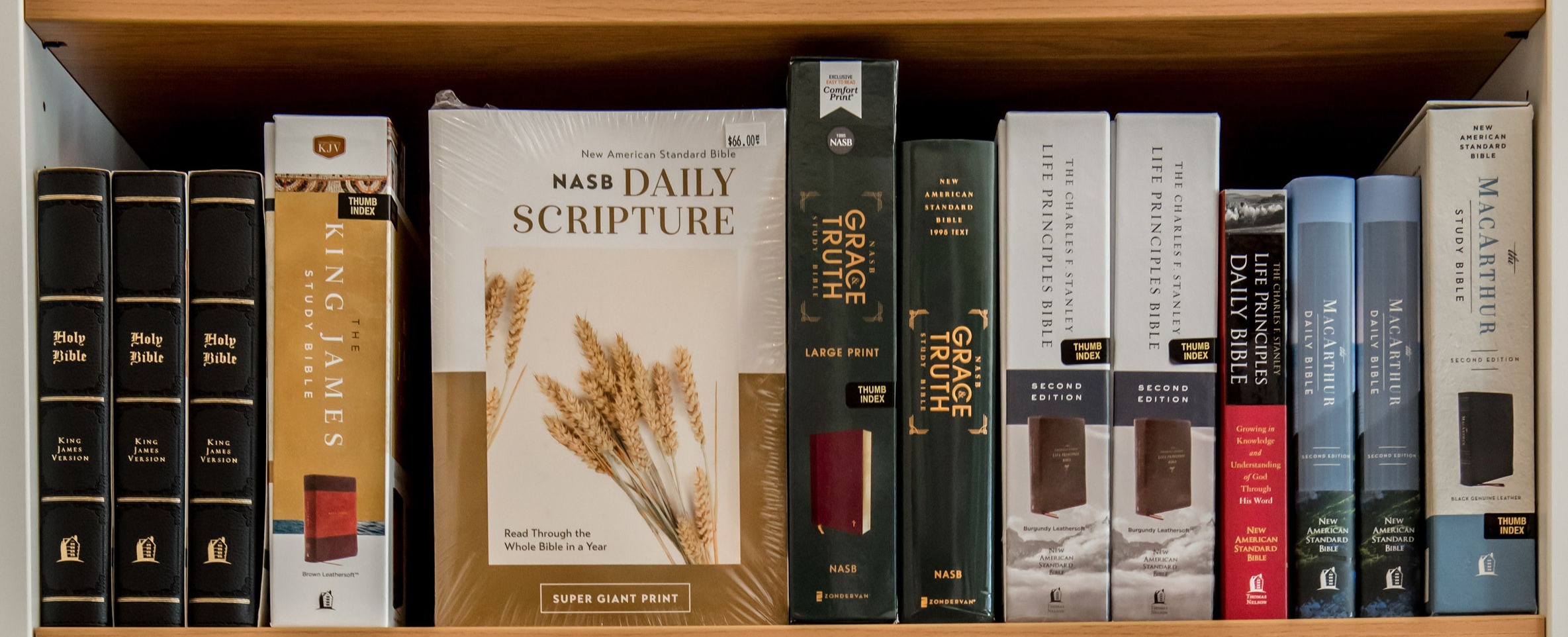
• Next, choose a translation. Going for a thought-for-thought version? Look for one that doesn’t stray too far. We recommend the NIV or the NLT at this time. Want a word-for-word? We recommend ESV, KJV, NASB, NKJV, or CEB (a mix of thought-for-thought and word-for-word, and coming to our store soon).
• Thirdly, select the type of Bible. Choose from chronological, colouring, daily devotional, journaling, life application, outreach, parallel translations, personal size, reference, study, or thinline. Also available are Bibles with specific preacher commentaries. The John MacArthur Study Bible, for example. Consider the benefits each type has to offer and how those will enhance a personal quiet time.
• Following that, consider the other existing features. Most applicable to adult Bibles, some features are the font size options, red-letter editions, and to index or not to index.
• Lastly, what cover option is best? What cover options are even available? Soft and hard cover. Cloth-covered board are also sometimes an option. LeatherSoft and genuine leather. To help you choose, consider who is going to use this Bible and for how long. Also, what colour do they like?
As you can see, this decision can be less daunting when you narrow down the options little by little. And you are not alone; The Study Room is here to help you. We not only offer advice, but we can order in a bible that is just right for you. Please don’t hesitate to reach out!
In the end, what would William Tyndale say if he saw all the options available to us? Honestly, I think he would be mostly pleased but a bit horrified by all the features, types, and translations. However, his legacy lives on through the millions who now have access to the Bible in English. By and large, we are a blessed people in a blessed time. To have such freedom to openly read the Word of God…may we not take it for granted! May we continue the work of excellence in translation that Tyndale started and of getting the Bible into the hands of the people. May we live bravely in our culture that is in the midst of its own chaos. And may we let today’s English Bibles transform us into servants for God’s glory as William Tyndale did.
Work Cited
Ryken, Leland. “The Word of God in English: Criteria for Excellence in Bible Translation.” Crossway, 2002.
Wayne, Israel. “Foundations in Faith.” MasterBooks Curriculum, 2023.

A blog post by Nathalie Davidson
Dec 10, 2025.